Publications
Generative models, biological dynamics, and representation learning.
* Equal contribution · † Shared secondary contribution
2026
- GeoSinkhorn FlowRead the paperbioRxiv 2026Perturbation responses · Geometric generative modeling
GeoSinkhorn Flow: Geometry-Aware Flow Matching for Perturbation-Conditioned Dynamics in Single cell Data Phenoscapes
bioRxiv, Oct 2026Preprint posted October 22, 2026Single-cell experiments often capture populations under different conditions without revealing how they move between those states. GeoSinkhorn Flow combines heat-diffusion geometry with conditional flow matching to infer continuous perturbation-response trajectories and predict responses to held-out conditions.
-
 PreprintRead the paper Preprint 2026Single-cell dynamics · Spatial transcriptomics
MIOFlow 2.0: A Unified Framework for Inferring Cellular Stochastic Dynamics from Single Cell and Spatial Transcriptomics Data
arXiv preprint arXiv:2603.22564, 2026Recovering cellular development from snapshots requires accounting for randomness, changing population sizes, and the surrounding tissue. MIOFlow 2.0 combines manifold learning, optimal transport, and neural differential equations to infer trajectories that incorporate all three.
-
 ICMLRead the paper ICML 2026Representation geometry · Language models
Dispersion Loss Counteracts Embedding Condensation and Improves Generalization in Small Language Models
In International Conference on Machine Learning (ICML), 2026In smaller language models, token representations can become concentrated in a narrow region of the embedding space. We study this embedding condensation and introduce a dispersion regularizer that improves representation geometry and benchmark performance without increasing the number of model parameters.
2025
-
 MLCBRead the paper MLCB 2025Cell–cell communication · Dynamical systems
STAGED: A Multi-Agent Neural Network for Learning Cellular Interaction Dynamics
In Proceedings of the 20th Machine Learning in Computational Biology Meeting, 2025Oral presentationCells influence one another, so predicting their behavior requires models of both communication between cells and regulation within them. STAGED combines agent-based modeling with graph neural differential equations to learn these coupled interactions from data.
-
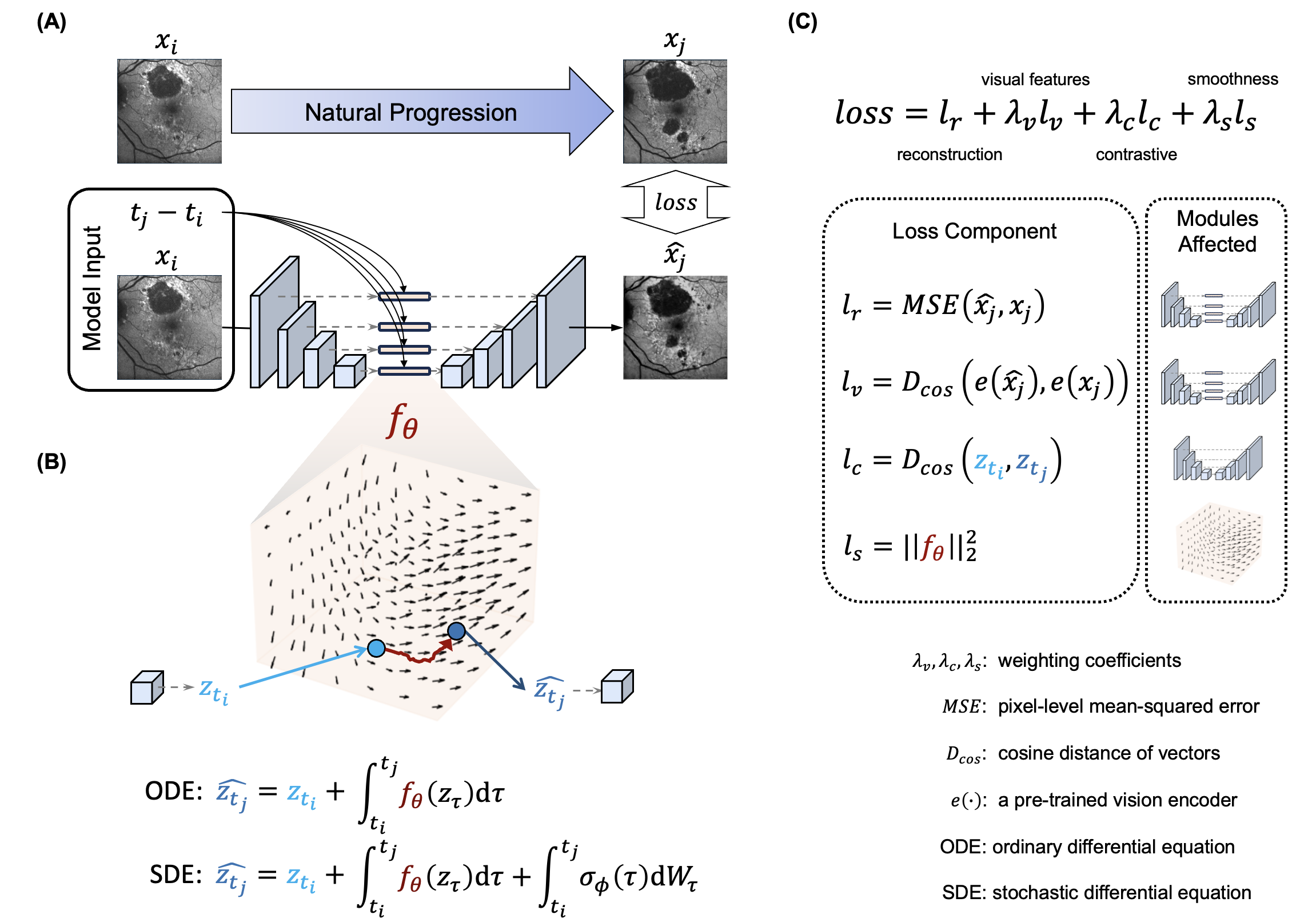 ICASSPRead the paper ICASSP 2025Medical imaging · Continuous-time forecasting
ImageFlowNet: Forecasting Multiscale Image-Level Trajectories of Disease Progression with Irregularly-Sampled Longitudinal Medical Images
In IEEE International Conference on Acoustics, Speech and Signal Processing (ICASSP), 2025Oral presentationMedical images are often collected at irregular intervals, making disease progression difficult to forecast. ImageFlowNet learns continuous dynamics in multiscale image representations to predict future images while preserving spatial detail and sharing information across patients.
-
 Nat CommunRead the paper Nat Commun 2025Gene regulation · Multi-omic time series
The chronODE Framework for Modelling Multi-Omic Time Series with Ordinary Differential Equations and Machine Learning
Nature Communications, 2025Time-resolved genomic measurements can reveal when genes activate and how their regulation changes. chronODE uses interpretable differential equations to characterize gene-expression and chromatin kinetics, then models their temporal relationships to predict expression changes from regulatory activity.