Ke Xu
New Haven, Connecticut

Ke Xu 许可

Ph.D. student in Computer Science, Yale University
Co-advised by Mark Gerstein and Smita Krishnaswamy

I develop machine learning methods to understand how biological systems change over time and respond to perturbations.

A sketch of biological dynamics Conceptual illustration
Possible trajectories through biological state space Four curves spread from a common starting point. Move the progress slider or press Replay to follow the curves. This is a conceptual illustration, not experimental data.

My research focuses on learning dynamics from sparse, high-dimensional observations. I combine geometry, optimal transport, and generative modeling to infer continuous trajectories, predict responses to new conditions, and understand interactions between cells.

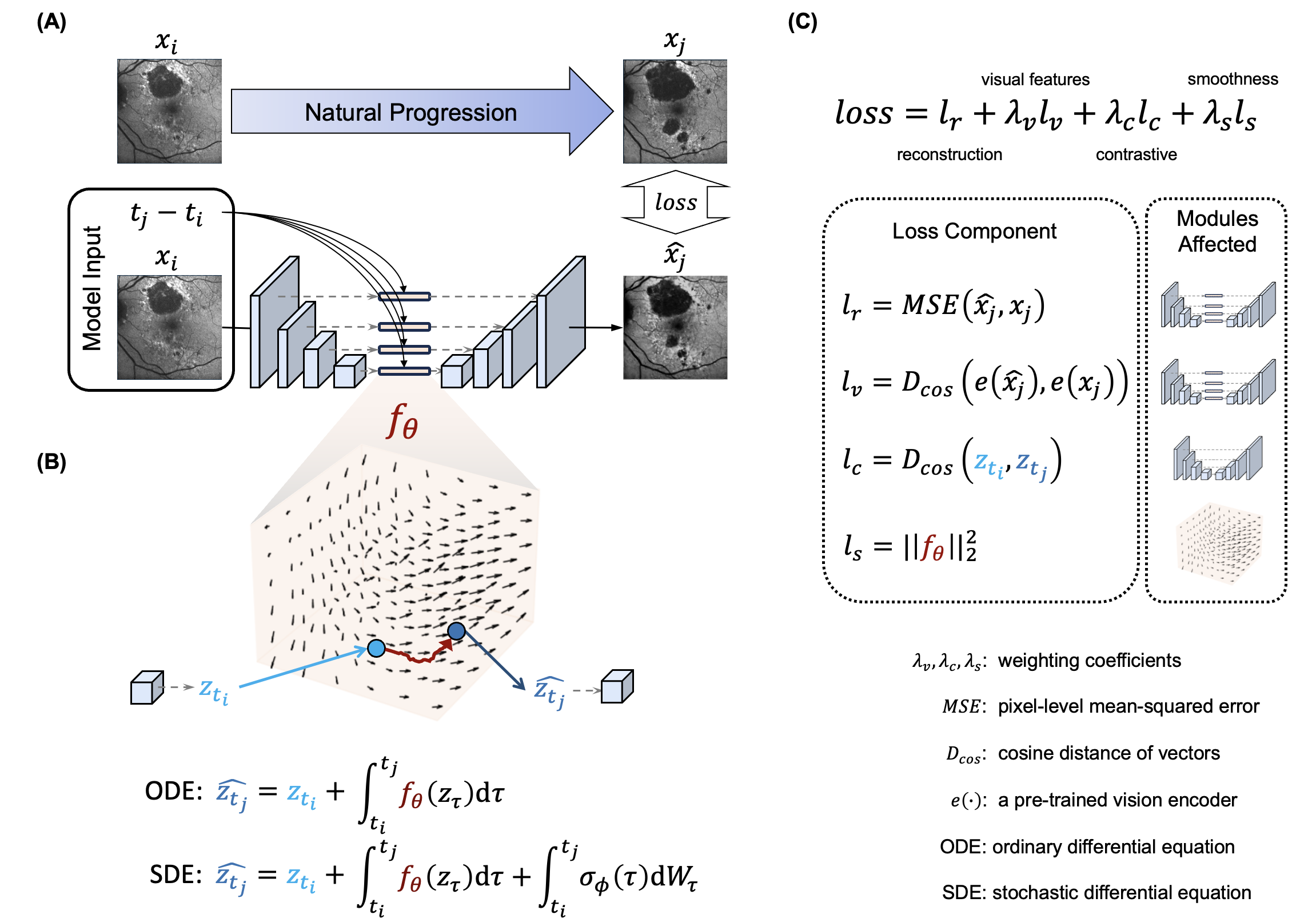
In GeoSinkhorn Flow, we turn static maps of cell populations into models of perturbation responses that generalize to held-out conditions. My work also includes ImageFlowNet, which forecasts disease progression in medical images (ICASSP 2025, Oral), and STAGED, which learns how communication between cells shapes their internal dynamics (MLCB 2025, Oral).

More broadly, I study interpretable models of gene regulation with chronODE (Nature Communications 2025) and the geometry of learned representations with Dispersion Loss (ICML 2026).

[10/2026] Our GeoSinkhorn Flow preprint is now available on bioRxiv.
[10/2026] Presented GeoSinkhorn Flow at the New England Computational Biology Symposium in Cambridge, MA.
[04/2026] Our work on Dispersion Loss for improving representation geometry in small language models was accepted to ICML 2026.
[09/2025] Our paper STAGED is accepted at MLCB 2025 (PMLR).
[07/2025] Our paper ChronODE is published in Nature Communications! Read it here.
[05/2025] Presented a poster on ChronODE at the Biology of Genomes meeting at Cold Spring Harbor Laboratory.
Selected work* Equal contribution · † Shared secondary contribution
  1. Perturbation responses · Geometric generative modeling

    GeoSinkhorn Flow: Geometry-Aware Flow Matching for Perturbation-Conditioned Dynamics in Single cell Data Phenoscapes

    Ke Xu, Alistair Wilkinson, Shuang Ni, Guillaume Huguet, Mark Gerstein, Guy Wolf, Christopher J. Tape, and Smita Krishnaswamy
    bioRxiv, Oct 2026
    Preprint posted October 22, 2026

    Single-cell experiments often capture populations under different conditions without revealing how they move between those states. GeoSinkhorn Flow combines heat-diffusion geometry with conditional flow matching to infer continuous perturbation-response trajectories and predict responses to held-out conditions.

  2. Cell–cell communication · Dynamical systems

    STAGED: A Multi-Agent Neural Network for Learning Cellular Interaction Dynamics

    João Felipe Rocha*, Ke Xu*, Xingzhi Sun*, Ananya Krishna, Dhananjay Bhaskar, Blanche Mongeon, Morgan Craig, Mark Gerstein, and Smita Krishnaswamy
    In Proceedings of the 20th Machine Learning in Computational Biology Meeting, 2025
    Oral presentation

    Cells influence one another, so predicting their behavior requires models of both communication between cells and regulation within them. STAGED combines agent-based modeling with graph neural differential equations to learn these coupled interactions from data.

  3. Medical imaging · Continuous-time forecasting

    ImageFlowNet: Forecasting Multiscale Image-Level Trajectories of Disease Progression with Irregularly-Sampled Longitudinal Medical Images

    Chen Liu*, Ke Xu*, Liangbo L. Shen†, Guillaume Huguet†, Zilong Wang, Alexander Tong, Danilo Bzdok, Jay Stewart, Jay C. Wang, Lucian V. Del Priore, and Smita Krishnaswamy
    In IEEE International Conference on Acoustics, Speech and Signal Processing (ICASSP), 2025
    Oral presentation

    Medical images are often collected at irregular intervals, making disease progression difficult to forecast. ImageFlowNet learns continuous dynamics in multiscale image representations to predict future images while preserving spatial detail and sharing information across patients.

  4. Gene regulation · Multi-omic time series

    The chronODE Framework for Modelling Multi-Omic Time Series with Ordinary Differential Equations and Machine Learning

    Beatrice Borsari*, Mor Frank*, Eve S. Wattenberg†, Ke Xu†, Susanna X. Liu†, Xuezhu Yu, and Mark Gerstein
    Nature Communications, 2025

    Time-resolved genomic measurements can reveal when genes activate and how their regulation changes. chronODE uses interpretable differential equations to characterize gene-expression and chromatin kinetics, then models their temporal relationships to predict expression changes from regulatory activity.

  5. Representation geometry · Language models

    Dispersion Loss Counteracts Embedding Condensation and Improves Generalization in Small Language Models

    Chen Liu*, Xingzhi Sun*, Xi Xiao*, Alexandre Van Tassel*, Ke Xu, Kristof Reimann, Danqi Liao, Mark Gerstein, Tianyang Wang, Xiao Wang, and Smita Krishnaswamy
    In International Conference on Machine Learning (ICML), 2026

    In smaller language models, token representations can become concentrated in a narrow region of the embedding space. We study this embedding condensation and introduce a dispersion regularizer that improves representation geometry and benchmark performance without increasing the number of model parameters.

Yale University

Master of Public Health in Biostatistics

2024

University of Wisconsin–Madison

Bachelor of Science in Mathematics

2022

Reviewer for NeurIPS 2024 and ICLR 2025.